
Prove what you've tested
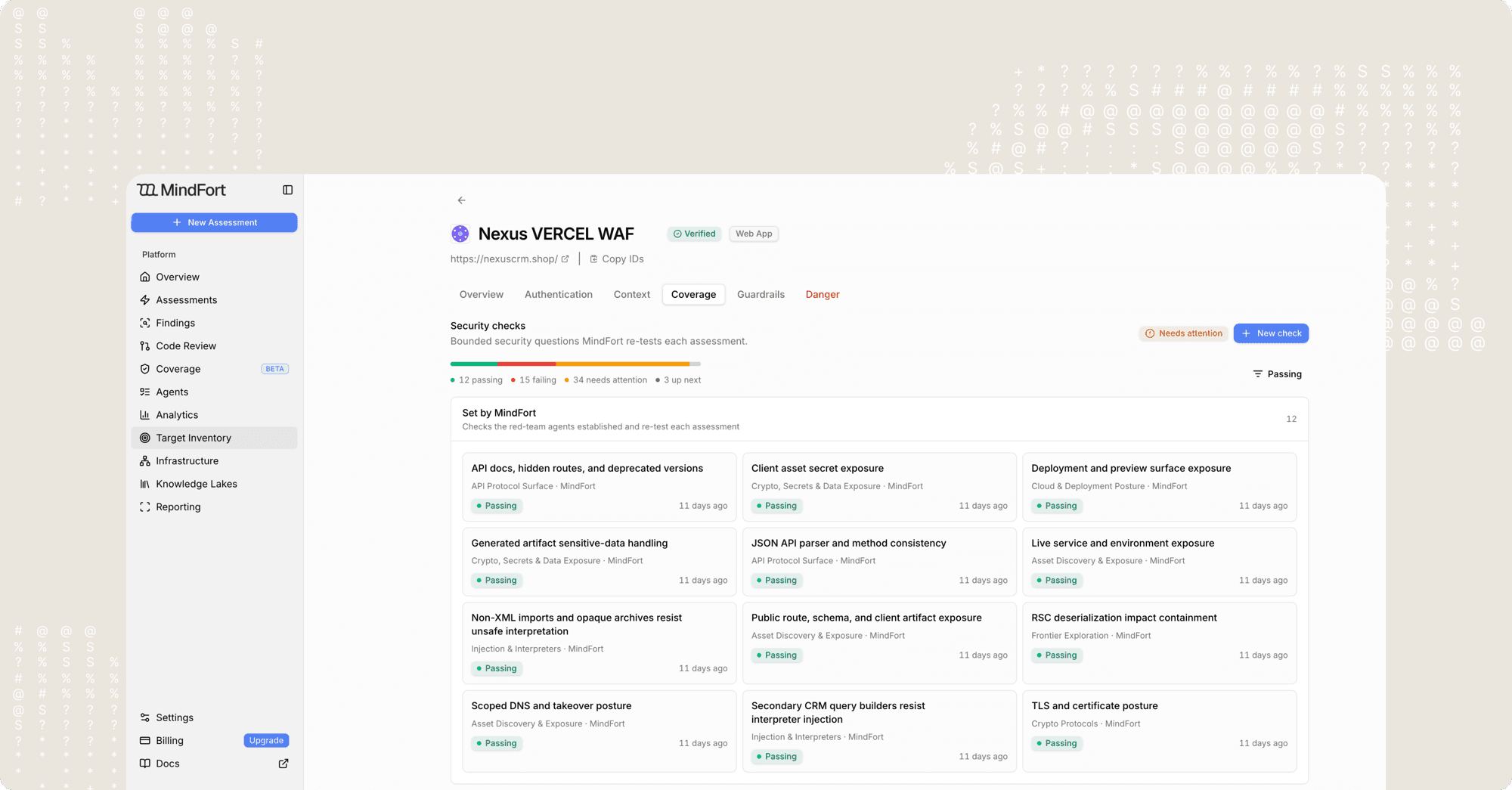
Agents track a security question for every part of your surface and re-answer it on every assessment. Coverage becomes something you can show an auditor.










How it works
A findings list tells you what broke. Coverage tells you what you checked.
Agents write the hypotheses
For each target, agents lay out the security questions worth answering: can this boundary be crossed, can this input reach that query, can this role read another tenant's data.
Each one gets an answer
Every assessment tests the open questions and marks them certified or failed.
Recertify with every run
Agents re-answer every question on each run and add new ones as your infrastructure changes, carrying prior results forward so each pass covers more in less time.
Security that gets better the longer it runs
Agents never start from scratch. They remember your stack, your deploy patterns, and your defenses, so every run starts smarter than the last.
Environment-aware testing
Agents map how your teams build, deploy, and configure systems, tailoring their testing and remediation to your specific stack and conventions.
Continuous context building
Every operation deepens an agent’s understanding of your environment. Past findings, infrastructure changes, and deployment patterns all inform future runs.
Adaptive attack strategies
Agents remember what worked and what didn’t. They evolve their approach based on your specific defenses, getting sharper with every cycle.
Efficient at scale
Agents skip re-discovering what they already know. That time goes into deeper testing and broader coverage.
Agent First
MCP native by default, persistent memory across runs, and a control surface designed for steering agents instead of configuring scanners.
MCP native by default
Agents discover and call tools through the Model Context Protocol, so your scanners, code hosts, ticketing, and cloud APIs plug in without glue code. Add a new MCP server and agents start using it on the next run.
Built to run continuously
Trigger on every CI/CD push, on a schedule, or always on. Agents probe, adapt, and remember what worked across operations instead of starting from scratch every time.