

MindFort vs Pentera
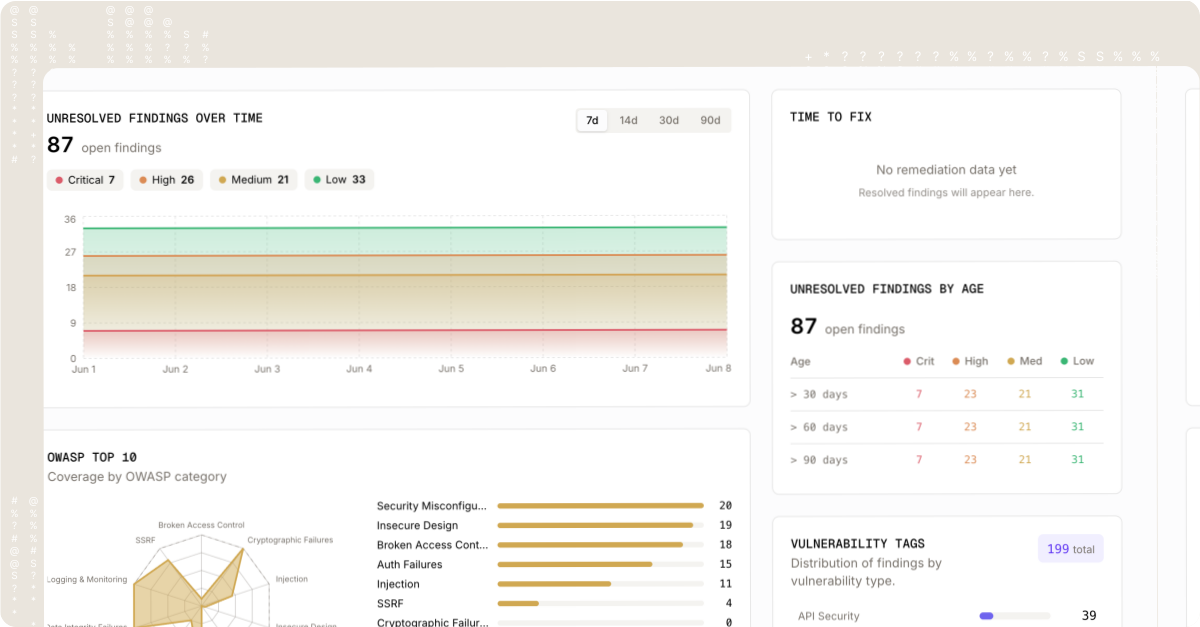
Pentera and MindFort are both autonomous AI pen testers. MindFort's agents chain exploits together, learn your environment, and try new methods on each pass, so coverage compounds over time. MindFort starts at $199/mo on a plan you can sign up for yourself, while Pentera quotes every deal through sales.
MindFort vs Pentera, head to head
Fully autonomous
White-box testing
Black-box testing
Pricing
Starting at $199/mo
Custom
Remediation guidance
Opens patch PR
PR security review
Unknown
Time to first results
Hours
Unknown
Web
API
Code
Endpoints
Network
Cloud
Infra
Business logic
CI/CD integration
GitHub integration
Jira integration
Linear integration
Slack integration
Every competitor cell comes from that vendor’s own site, docs, or announcements, verified between July and October 2026. “Unknown” means the vendor does not state it publicly.
Built for teams that ship fast
Continuous, exploitation-based testing that keeps pace with your releases.
Hours
First Results
24/7
Coverage
<1%
False Positives
Minutes
Setup
Deploy your security agent swarm today.
Deploy AI security agent swarms that continuously pen test, prove every vulnerability with a working proof of concept, and ship the patch.
Frequently Asked Questions
Common questions about MindFort and Pentera.
Yes. Pentera runs black-box and gray-box security validation across internal networks, external assets, cloud, and hybrid environments. It added AI web app pentesting in beta in 2026. MindFort reads your source code alongside the running app, reviews every pull request, and opens a patch PR for each finding it proves by exploitation.
Both are autonomous AI pen testers, but the architecture differs. Pentera pairs an AI layer that plans and adapts attacks with a built-in deterministic engine that keeps every test safe, repeatable, and within customer-controlled boundaries. MindFort runs with guardrails too, but its agents chain multiple exploits together and learn your environment over time through HillClimb, its recursive learning infrastructure, trying new attack methods on each pass so results improve the longer they run. MindFort also tests with white-box access to your source code and opens a patch pull request for every vulnerability it proves.
Yes. Like Pentera, MindFort operates within guardrails and customer-defined boundaries. The difference is what happens inside them: rather than following a fixed, deterministic test plan, MindFort's agents chain exploits and try new attack paths to surface issues a static plan would miss, and prove each one with a working exploit before opening a patch PR.
Not directly. Pentera Resolve consolidates and prioritizes validated findings, assigns owners, and routes tickets to tools like Jira and ServiceNow, but it does not generate code patches or open pull requests. MindFort opens a patch pull request for every confirmed vulnerability and retests once the fix is deployed.
No. Pentera is black-box and gray-box (assumed-breach), so it does not read or analyze your source code. The integrations it groups under code security connect to repositories and pipelines such as GitHub, GitLab, Bitbucket, and Jenkins rather than testing the code itself. MindFort tests with white-box access to your code alongside black-box exploitation, so it can trace a proven exploit back to the vulnerable code and patch it.
MindFort starts at a transparent $199/mo on a self-serve plan. Pentera publishes no pricing at all: there is no pricing page, and every path into the product goes through a sales conversation, so what you pay depends on the scope you negotiate.