

MindFort vs Mythos
Claude Mythos is Anthropic's most capable cybersecurity model. It is available only through Anthropic's trusted access programs and priced per token. It finds vulnerabilities, and it can write a working exploit for one. What it does not do is scope your target, run against your deployed system, or own the fix through a pull request and a retest. MindFort does all of that, starting at $499 a month.
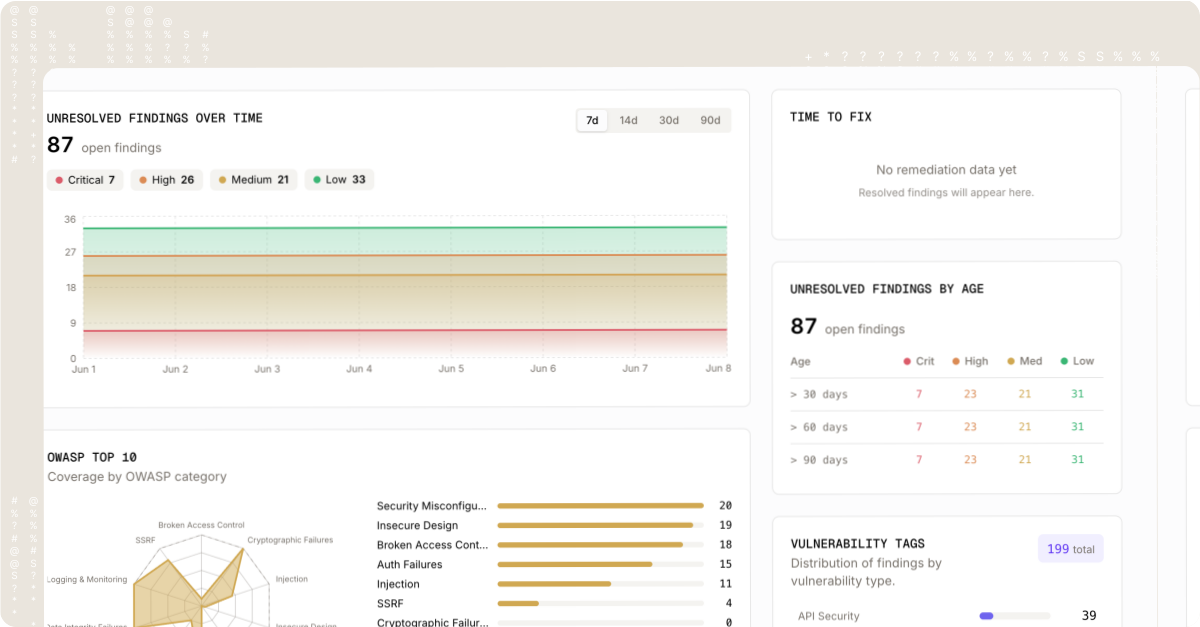
MindFort vs Mythos, head to head
Primary approach
Autonomous pen test platform
Frontier security model
Generally available
Tests at runtime
Web
API
Endpoints
Network
Cloud
Infra
Business logic
Source code analysis
Writes a working exploit
Chained multi-step exploits
Writes the fix
Opens patch PR
PR security review
Retests after the fix
Continuous testing
CI/CD integration
GitHub integration
Jira integration
Linear integration
Slack integration
Time to first results
Hours
Unknown
Pricing
Starting at $499/mo
Usage-based
Every competitor cell comes from that vendor’s own site, docs, or announcements, verified between July and October 2026. “Unknown” means the vendor does not state it publicly.
Built for teams that ship fast
Continuous, exploitation-based testing that keeps pace with your releases.
Hours
First Results
24/7
Coverage
<1%
False Positives
Minutes
Setup
Deploy your security agent swarm today.
Deploy AI security agent swarms that continuously pen test, prove every vulnerability with a working proof of concept, and ship the patch.
Frequently Asked Questions
Common questions about MindFort and Mythos.
Not in the usual sense, because the two are different kinds of thing. Claude Mythos is a model, which Anthropic describes as its most capable model for cybersecurity and biology research. MindFort is a product, and what it does is the work that surrounds a model: scoping the target, running the test, proving each vulnerability with a working exploit, opening the patch pull request, and retesting once the fix ships. You cannot buy Mythos and get that. You would have to build it.
Only through Anthropic's trusted access programs. As of October 2026, Anthropic offers Claude Mythos 5.1 there to vetted cyberdefenders at a set of US organizations, from $10 per million input tokens. Claude Enterprise customers can also get Mythos 5.1 scans through Claude Security, now in public beta. MindFort is self-serve from $499 a month, with first results in hours.
Binaries. Anthropic evaluated Mythos on closed-source reverse engineering and binary analysis, finding memory-safety bugs across major operating systems and browsers and writing working exploits for them. MindFort does not do binary reverse engineering. It tests source code, deployed applications and APIs, and the network, cloud, and infrastructure they run on.
It can draft a patch when asked: Anthropic says some Glasswing partners use the model to write patches and run pre-release checks. On its own, the model opens no pull request and runs no retest. Anthropic reports findings to the relevant maintainers and waits for them to patch. MindFort opens the patch pull request for every vulnerability it proves and retests once the fix is deployed.
Because the same model produces very different results depending on what is built around it. Anthropic's own researchers reach their results through agentic scaffolds they build around the model, and Anthropic has released pieces of that scaffolding, including skills and a harness that helps Claude map a codebase and write reports. What none of it adds up to is a pen tester pointed at your running systems: assembling that, and keeping it working, is still your job. MindFort is the scaffolding, built and maintained for you: recon, exploitation, chaining, proof, the patch pull request, and the retest, plus HillClimb, its recursive learning infrastructure, so coverage compounds with every pass.